Not automated health checks

It decides what
to test next.

Instead of running a fixed sequence, Zenobia uses each result to narrow the possible causes and choose the next experiment.

The failure mode to avoid

Automation alone does not make a test intelligent.

A very fast checklist is still a checklist. It can repeat the same blind spots at higher speed.

Static health checksSame questions. Same order.
  1. 01

    Alert

    A symptom is detected.

  2. 02

    Collect logs

    A large archive is attached.

  3. 03

    Run checklist

    The same health checks run again.

  4. 04

    Escalate

    The machine can still be unexplained.

  • Optimized for broad screening
  • Produces pass / fail and logs
  • Can miss the original operating conditions
  • Does not explain what the machine can safely do next
Zenobia investigationEvery result changes the path.
  1. 01

    Keep the incident

    Preserve the conditions that made the failure real.

  2. 02

    Maintain alternatives

    Track several possible causes and what would distinguish them.

  3. 03

    Choose one experiment

    Select the safest action that can eliminate the most uncertainty.

  4. 04

    Read the response

    Compare the suspect system with its baseline and matched controls.

  5. 05

    Update what remains

    Rule possibilities in or out, then choose again.

  6. 06

    Stop at a decision

    Return an operating envelope, repair action, or precise next request.

  • Starts from the actual incident
  • Chooses tests for what they can rule out
  • Stops when a disposition is justified
  • Leaves a reusable, executable case

Illustrative investigation

Watch the possibility set get smaller.

This example shows the behavior of the system, not a reported customer result. The important point is that no test is chosen in advance of the evidence that makes it useful.

  1. 01
    Hold workload constant; vary temperature.

    The phenomenon appears only in a narrow high-temperature range.

    Next: separate a generic thermal effect from a workload-sensitive one.
  2. 02
    Hold temperature; vary the memory pattern.

    One approved synthetic pattern sharply increases the event frequency.

    Next: determine whether it follows the suspect device.
  3. 03
    Run the same pattern on matched healthy nodes.

    The response diverges only on the suspect device under the defined conditions.

    Next: ask for the vendor-only capability that can localize the mechanism.
  4. 04
    Return a useful decision before perfect certainty.

    Provisional operating envelope plus a precise request for protected vendor telemetry.

    What remains possible, what is ruled out, and what settles the question are explicit.

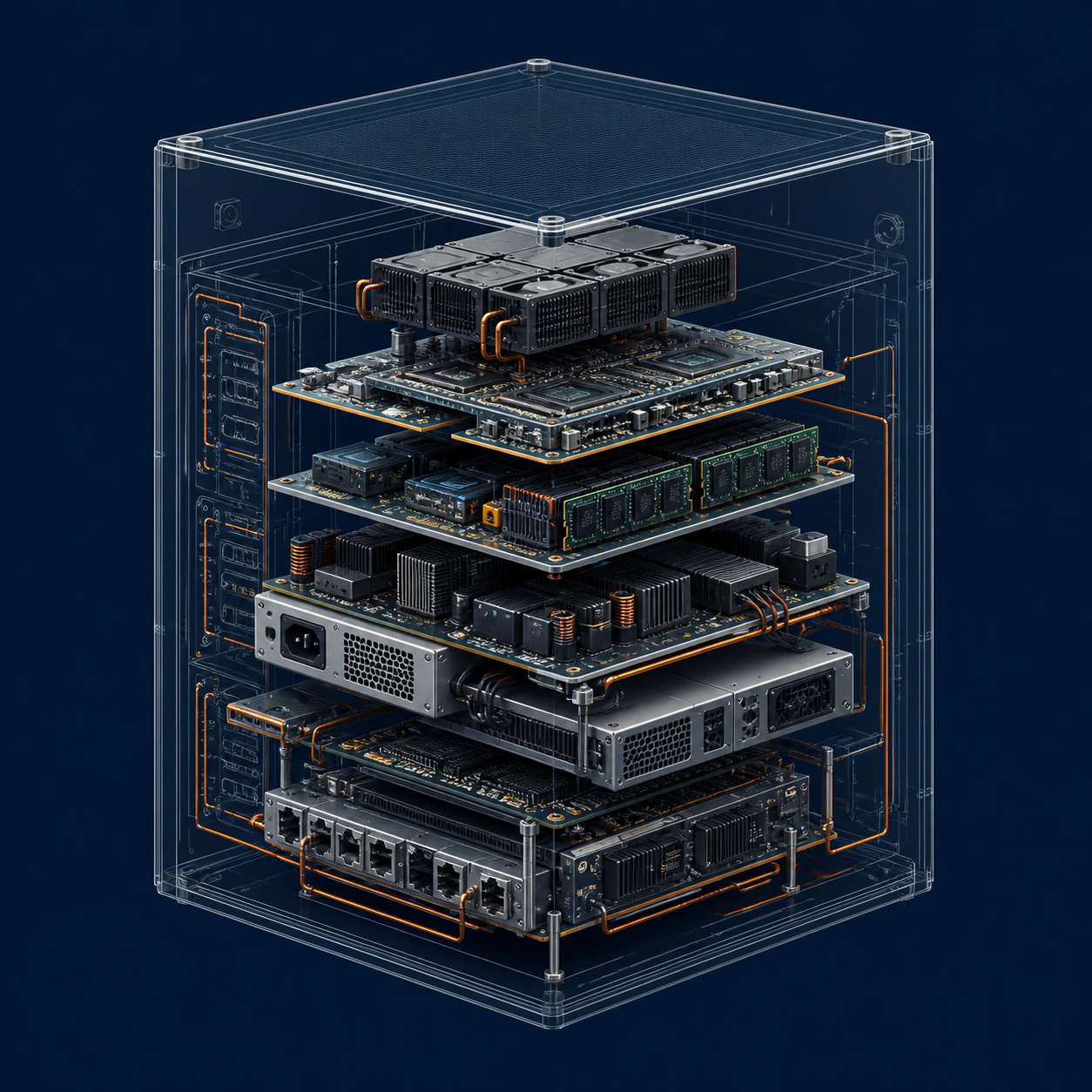
Inside the isolated machine

The agent can sense and act across the physical stack.

Broad access matters because difficult failures often live between layers. Zenobia combines many ordinary capabilities into one adaptive instrument.

Thermal sensing

Oscillating calibrated sensors across the stack.

Power analysis

Per-rail, transient, phase-resolved response.

Memory introspection

Register reads, ECC, retention, and stress patterns.

Timing calibration

Latency, skew, and jitter across compute, network, and tray-control domains.

Cutaway illustration of the Zenobia agent operating inside an isolated hardware system

Workload injection

Synthetic, micro, and approved real-world workloads.

Performance counters

Hardware PMU, custom counters, and synchronized traces.

Firmware & configuration

BIOS, BMC, drivers, policies, and governors.

Topology discovery

Connections, lanes, links, switches, and dependencies.

Sense → choose → act → measure → update → repeat, until the smallest useful explanation remains.

Powerful by reach. Safe by construction.

The action space is wide. The authority is narrow.

Zenobia’s ability to intervene does not imply permission to do anything it can do.

Pre-approved actions

Only capabilities authorized for the quarantined asset can run.

Hard operating limits

Temperature, power, timing, and other bounds have automatic stops.

Append-only experiment record

Every action, parameter, response, and decision is time-linked.

Matched controls

Comparable healthy systems help separate a real signal from fleet noise.

Local data boundary

Production data remains local; approved synthetic reproducers carry the phenomenon.

Separate authority

Operators approve action and disclosure; receiving parties control their environments.

The compounding specialist

A closed case improves the instrument.

Every resolved investigation can leave behind the decisive experiment, a safer reusable method, a smaller reproducer, an acceptance condition, and a better starting point for the next case.

Resolved caseReusable methodBetter next investigation

Continue the investigation

See what the system decides—not just what it detects.

Walk through the adaptive loop, safety envelope, and case output with our team.